









Physical Education
What is the intention of the curriculum?
We endeavour to provide positive experiences to promote lifelong engagement in sport and exercise; as well as offering individuals opportunities to achieve their optimum potential in physical education.
Sport plays an important part in the life of the school Harris Academy Orpington seeks to enable each student to participate and pursue their chosen sport to the highest level whilst providing all students of the school with the opportunity to enjoy and experience a variety of physical activities. Additionally, the development of personal skills within a social setting can be enhanced by participating in an appropriate and sensitively designed Physical Education programme.
-
To promote a healthy active lifestyle – both to develop and retain a rich knowledge of health and fitness; and to ensure students possess the physical skills to do so.
-
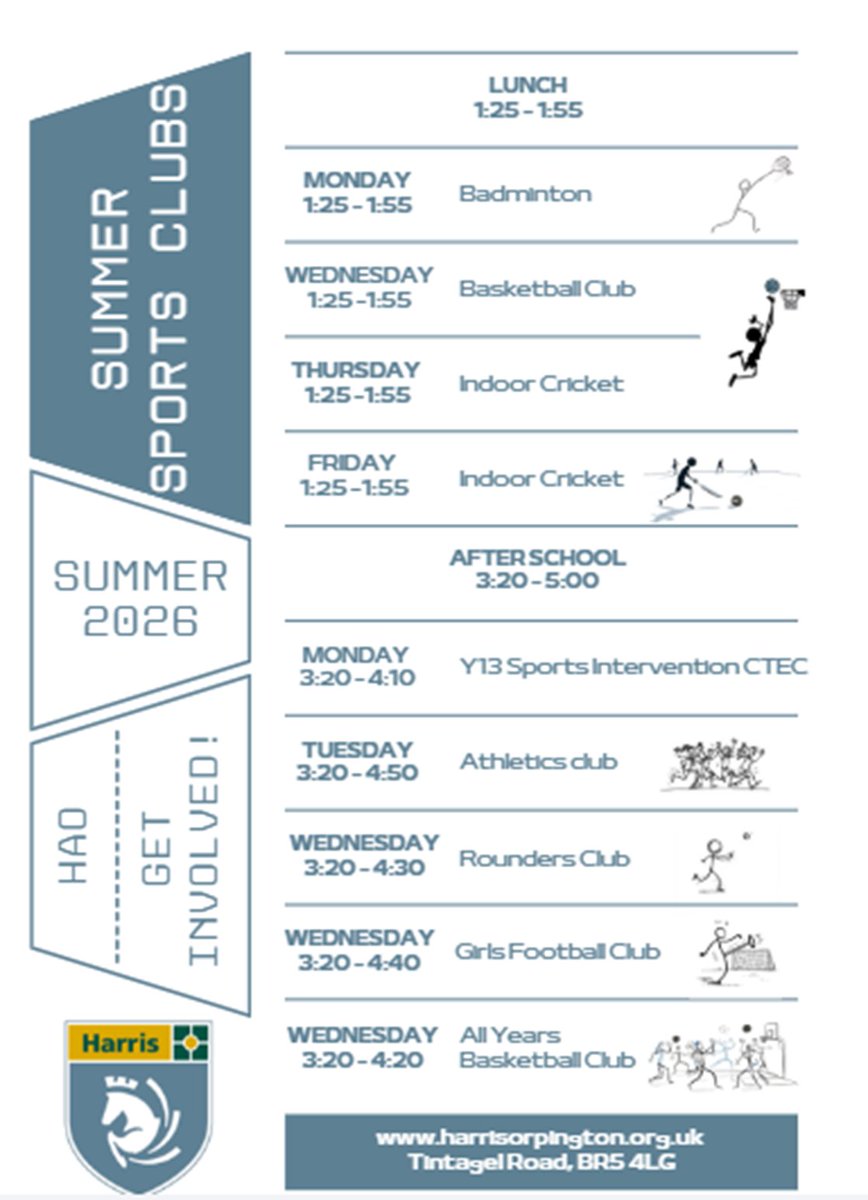
To provide opportunities to expand their involvement and experiences in sport through our extracurricular programme.
-
To apply physical education curriculum that incorporates the 3 domains of learning – the Hands (motor competency), the Head (cognitive competency), and the Heart (attitude to learning and participation) …
HANDS: To help students build a number of motor skills and physical competency.
HEAD: To increase understanding of rules, techniques, tactics and strategies to excel in activities, sports, and games.
HEART: To explore and enhance feelings, attitudes, and values in sport such as resilience and teamwork.
Key Stage 3
Our Key Stage 3 Physical Education curriculum develops physically literate, confident and resilient learners who understand the importance of lifelong participation in physical activity. Through an ambitious and inclusive curriculum, all students develop the knowledge, skills and personal qualities needed to lead healthy, active lives, regardless of their starting point.
Across Years 7–9, students progressively build their understanding of rules, tactics, strategies, health and fitness while developing fundamental movement skills, sport-specific techniques and decision-making across a range of individual and team activities. Our carefully sequenced curriculum follows a spiral approach, revisiting key concepts to deepen understanding and improve long-term retention.
Students experience a broad curriculum that includes:
-
Invasion games,
-
Net and wall games,
-
Striking and fielding activities
-
Athletics
-
Dance & Outdoor and adventurous activities
-
Health-related fitness
This breadth enables students to develop physical competence in a range of sports alongside transferable skills such as communication, resilience, leadership and teamwork.
Beyond lessons, a wide range of extracurricular clubs, fixtures and enrichment opportunities encourage students to develop a lifelong enjoyment of sport and physical activity. By the end of Key Stage 3, students have the confidence, competence and knowledge to make informed choices about their health and wellbeing and are well prepared for Key Stage 4 Physical Education.
Key Stage 4
Our Key Stage 4 Physical Education curriculum builds on the foundations established at Key Stage 3, developing confident, independent and physically active young adults who value lifelong participation in sport and physical activity. Through a broad and inclusive curriculum, students develop the knowledge, skills and confidence to make informed choices about their health and wellbeing.
Students deepen their understanding of tactics, strategies, rules, training methods and health-related fitness while refining practical skills across a range of activities. They apply this understanding through increasingly challenging practical activities, refining techniques, solving performance challenges and making informed decisions in a range of sporting contexts.
Our curriculum remains broad and balanced, offering a diverse programme that includes:
-
Invasion games,
-
Net and wall games,
-
Striking and fielding activities
-
Athletics
-
Health-related fitness
-
Alternative sports
Students also develop valuable personal qualities by taking on roles such as performer, leader, coach and official. These opportunities promote leadership, communication, teamwork, resilience and respect while encouraging students to take responsibility for their own learning and performance.
By the end of Key Stage 4, students have the confidence, competence and understanding to participate independently in physical activity, make positive lifestyle choices and leave school equipped for lifelong participation in sport, exercise and active recreation.
Key Stage 4 Qualification
Additionally, at Key Stage 4, students have the opportunity to study the OCR Cambridge National in Sport Studies (Level 2), a vocational qualification that develops both academic understanding and practical application within the sports industry. The course is designed for students with a genuine interest in sport, physical activity and leadership, providing a meaningful pathway for those wishing to pursue further study or careers within the sport, leisure and health sectors.
Our curriculum builds upon the knowledge, skills and experiences developed throughout Key Stage 3, enabling students to deepen their understanding of the wider role that sport plays in society while developing transferable skills that can be valued by further education providers and employers.
The curriculum balances theoretical learning with practical experiences, ensuring students understand not only how to perform within sport, but also why sport is organised, delivered and experienced in different ways across local, national and international contexts. Students are encouraged to analyse contemporary issues, evaluate evidence, justify opinions and apply their learning to realistic sporting scenarios.
The qualification prepares students for progression to Level 3 vocational qualifications, A Level Physical Education, apprenticeships and careers across the sport, fitness, coaching, leisure and public service sectors. Throughout the course, students develop confidence, resilience and professionalism while gaining an understanding of the knowledge and behaviours expected within the modern sports industry.
The course consists of three complementary units:
Unit R184: Contemporary Issues in Sport (Externally Assessed)
Students investigate the social, cultural and ethical factors that influence participation in sport. They explore topics including equality, inclusion, barriers to participation, technology, major sporting events and the role of National Governing Bodies, developing the ability to evaluate contemporary issues within sport.
Unit R185: Performance and Leadership in Sports Activities (Internally Assessed)
Students develop practical performance alongside the knowledge and skills required to plan, lead and evaluate safe, inclusive sporting activities. Through leadership opportunities, they build confidence, communication, organisation and reflective practice.
Unit R186: Sport and the Media (Internally Assessed)
Students examine how different forms of media influence sport, participation and commercialisation. They evaluate the impact of media on performers, organisations and spectators while developing analytical, research and presentation skills.
By the end of the course, students will have developed a secure understanding of sporting sector, the confidence to lead and evaluate practical activities and the knowledge, skills and behaviours needed to progress successfully into further education, training or employment within the sport and physical activity industry.
Key Stage 5 Qualifications
Students in Years 12 and 13 can continue their studies through the Cambridge Technical Level 3 Extended Certificate or Diploma in Sport and Physical Activity. These qualifications develop the specialist knowledge, practical skills and professional behaviours needed for higher education, apprenticeships and careers within the sport, health and leisure industries.
The curriculum builds on learning from Key Stage 4 while remaining accessible to students new to the subject. Students develop their understanding of sports science, coaching, leadership, psychology, performance analysis and the wider sporting industry through a combination of practical experiences and academic study.
Alongside technical knowledge, students develop valuable transferable skills including communication, teamwork, leadership, organisation, problem-solving, resilience and critical thinking. The course encourages independent learning and prepares students for progression to university, apprenticeships and careers in areas such as coaching, physiotherapy, teaching, sport science, the armed forces and the health and fitness sector.
By the end of Key Stage 5, students have the confidence, knowledge and practical skills to progress successfully into further education or employment while recognising the importance of lifelong participation in physical activity and healthy living.
Curriculum Content
The qualification includes a range of mandatory and optional units, including:
-
Unit 1: Body Systems and the Effects of Physical Activity (External Assessment)
-
Unit 2: Sports Coaching and Leadership
-
Unit 3: Sports Organisation and Development (External Assessment)
-
Unit 4: Working Safely in Sport, Exercise, Health and Leisure (External Assessment)
-
Unit 5: Performance Analysis in Sport and Exercise
-
Unit 8: Organisation of Sports Events
-
Unit 11: Physical Activity for Specific Groups
-
Unit 13: Health and Fitness Testing for Sport and Exercise
-
Unit 17: Sports Injuries and Rehabilitation
-
Unit 18: Practical Skills in Sport and Physical Activities
-
Unit 19: Sport and Exercise Psychology
How will this be implemented?
KS3 Core PE
-
Five to six sports are planned across one year and delivered in a half-termly rotation. Each sport has been designed to include opportunities for pupils to develop the three domains of learning.
-
We actively encourage staff to interpret the medium-term plan and the five to six activities to be appropriate for their class context, ability and interest.
-
The medium-term plans have been planned for Harris Academy Orpington staff to follow and utilise i.e. 6-10 lessons (approximately one half term)
KS4 Core PE
-
Five to six sports are planned across one year and delivered in a half-termly rotation. Each sport has been designed to include opportunities for pupils to engage in physical activity in an effective and enjoyable manner so that they make informed lifelong decisions about health and fitness in their future lives.
-
We actively encourage staff to interpret the medium-term plan and the five to six activities to be appropriate for their class context, ability and interest.
-
The medium-term plans have been planned for Harris Academy Orpington staff to follow and utilise i.e. 6-10 lessons (approximately one half term)
KS4 Examination PE
-
120-guided-learning-hour qualification (equivalent in teaching time to one GCSE) is planned across two years, with some foundation and preparation work beginning in Year 9.
-
The Long- Term Plan and Medium- Term Plans have been planned for staff to follow and utilise i.e. one unit per one-and-a-half terms). Staff set agreed tasks in line with the assignments briefs for each unit.
-
The majority of the units are assessed through internal assessment, which means that we can deliver the programme in a way that suits our learners.
-
Pupils are given all the preparation, feedback and support they need to undertake an assessment before they begin producing their evidence.
KS5 Examination PE
-
360-guided-learning-hour qualification for the extended certificate (equivalent in teaching time to one A-Level) and 540-guided-learning-hour qualification for the diploma (equivalent in teaching time to two A-Levels) is planned across two years.
-
Lesson structure and long-term planning follows the same format as Key Stage 4 lessons, other than an increased emphasis on independent learning so lessons are focused on depth of knowledge and application.
-
The majority of the units are assessed through internal assessment, which means that we can deliver the programmes in a way that suits our learners and which relates to the local need.
-
Pupils are given all the preparation, feedback and support they need to undertake an assessment before they begin producing their evidence.
To monitor the quality of teaching by physical education, staff leadership within the department will complete learning walks, book scrutinises, and observations to ensure that students at Harris Academy Orpington are taught to the highest possible standard and that teachers are held accountable for the learning of their classes. Feedback is then given to teachers and either best practise can be shared or any necessary support can be put into place.
How will we judge the impact of this curriculum?
The impact of our Key Stage 3 Physical Education curriculum is measured through ongoing assessment of students' development across the three domains of learning: Head, Hands and Heart. Students are assessed on their knowledge and understanding of tactics, rules and decision-making (Head), their physical competence, control, power and endurance (Hands), and their attitude, leadership, commitment and sportsmanship (Heart). Regular teacher assessment, observation and feedback enable students to recognise their strengths and areas for improvement. This holistic approach ensures students make sustained progress, develop confidence and resilience, and are well prepared for Key Stage 4 and lifelong participation in physical activity.
At Key Stage 4 CORE the students will demonstrate positive engagement in sport and exercise through a programme tailored to their needs in order that the positive engagement continues beyond the classroom.
Students at Key Stage 4 and Key Stage 5 within the examined curriculum will gain qualifications which allow them to access further education courses and pursue possible careers in all areas of the sports and exercise industry.